
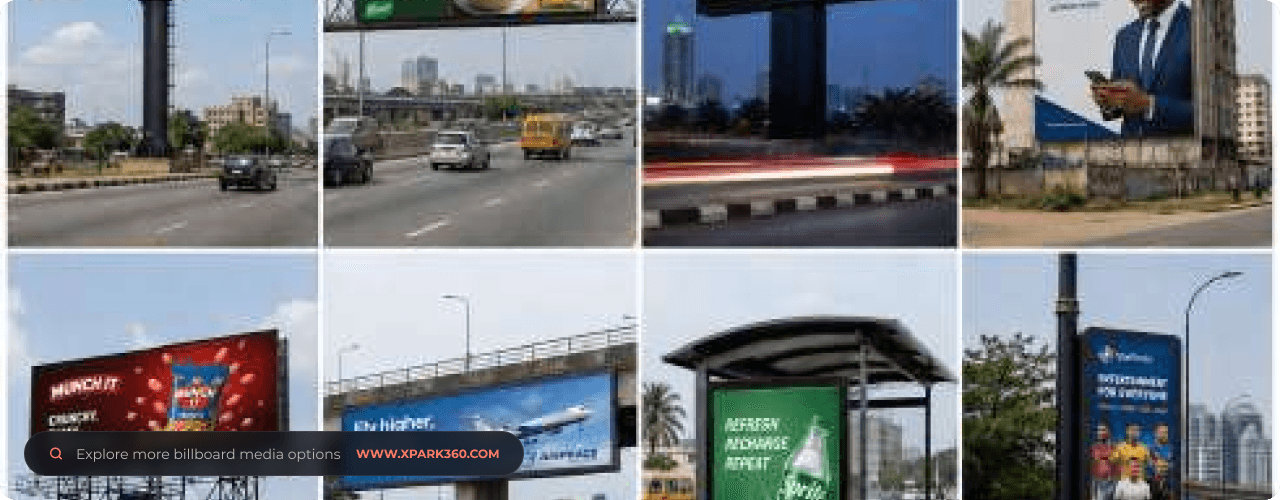
A brand books a bright LED screen at a busy Lagos junction because it looks impressive. The campaign goes live, the photographs look good, and everyone congratulates the team.
There is only one problem: the message needed continuous visibility, but it appeared for a few seconds inside a crowded advertising loop.
That is what happens when brands choose billboard formats by appearance instead of purpose.
The different types of billboards in Nigeria are built for different viewing conditions. A static unipole on the Lekki-Epe Expressway does not work like an LED screen at a busy junction. A wall drape can dominate a building, while a lamp-post sequence builds attention through repetition. A bus-shelter panel may give people time to read, but a gantry has to make sense almost immediately.
The biggest board is not automatically the best board. The right format is the one that gives your message the best chance of being noticed, understood and remembered.
First, billboard or outdoor advertising format?
Billboards are part of the wider out-of-home advertising category, commonly called OOH.
OOH also includes airport displays, transit advertising, vehicle branding, street furniture, mall media and other public-facing formats. People often call all of them billboards, but the distinction matters when planning creative and buying media.
Someone waiting near a bus shelter may have several seconds to study a message. A passenger inside Murtala Muhammed International Airport may have even longer. A driver approaching a gantry on an expressway may only get a quick glance.
Using the same artwork across all three environments is not consistency. It is lazy adaptation.
Before selecting a format, understand how people will encounter it. Viewing distance, traffic speed, dwell time, lighting and the surrounding environment should shape the decision.
Static billboards
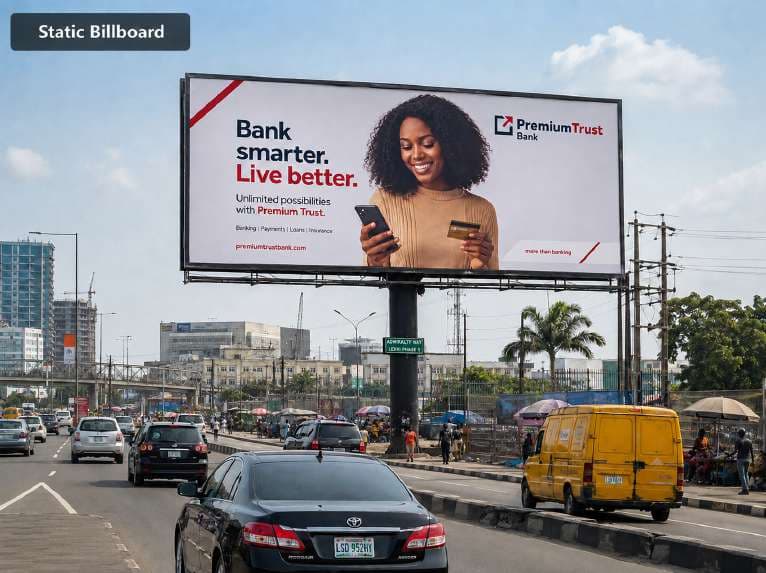
A static billboard uses printed material fixed to a structure for the campaign period. The creative remains unchanged unless the material is physically replaced.
Static boards are useful when a brand wants one message to stay visible throughout the day. They work well for long-running awareness campaigns, permanent directions, product statements and ideas that become stronger through repetition.
They can also give an advertiser complete ownership of the board face. There is no rotation and no waiting for the message to return after another advertisement.
Static does not mean ordinary. Cut-outs, extensions, special lighting and creative use of the structure can turn a printed board into something people photograph and discuss.
But execution should never overpower clarity. If people notice the trick but cannot remember the brand, the billboard entertained them for someone else's benefit.

Digital or LED billboards
Digital billboards use electronic screens and usually display several advertisers within a repeating loop. Creative can be uploaded, changed or replaced without producing a new printed skin.
This flexibility makes digital useful for campaigns with changing messages, product variations, countdowns and time-sensitive announcements.
Digital can also support simple animation, but simple is the important word. A billboard is not a short film. The main message should be clear from the first frame.
A beautiful screen with a weak display schedule can be less useful than a modest static board with continuous visibility.
Unipoles
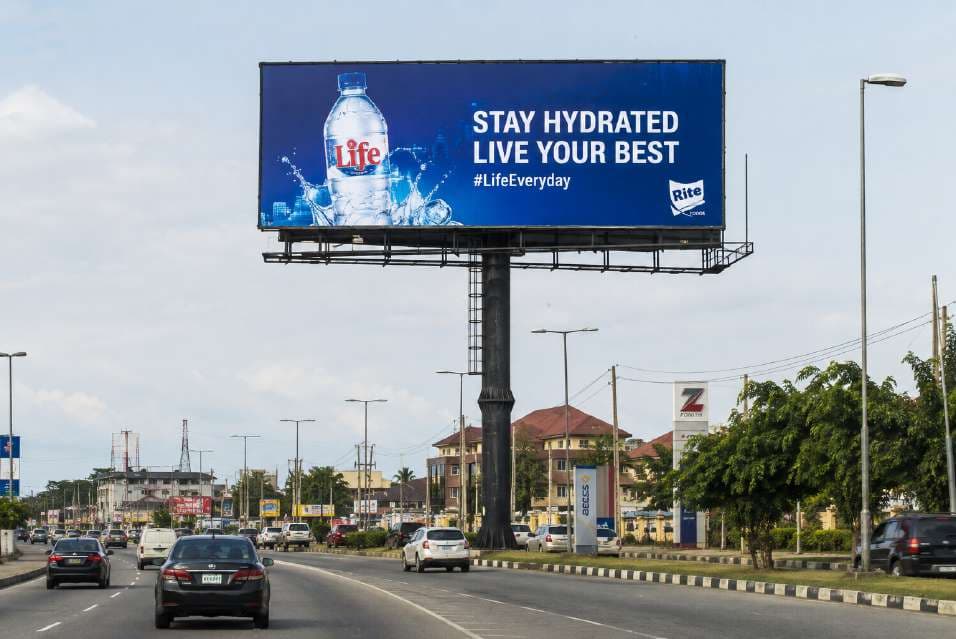
A unipole is a large billboard supported by one tall column. Its height can help it rise above roadside structures and remain visible from a longer distance.
Unipoles are common choices for major road corridors and large awareness campaigns. They suit strong product imagery, recognisable faces and short, confident brand statements.
A unipole along the Lekki-Epe Expressway, Abuja Airport Road or another open corridor may become visible well before the audience reaches it. That gives the message time to register, but only when the design is built for distance.
Small type dies on a unipole. So do detailed product descriptions, long website addresses and several competing messages.
The board may look enormous when viewed up close, but that is not how the audience experiences it. Test the artwork at a reduced size or from a realistic distance before approving it.
Gantries
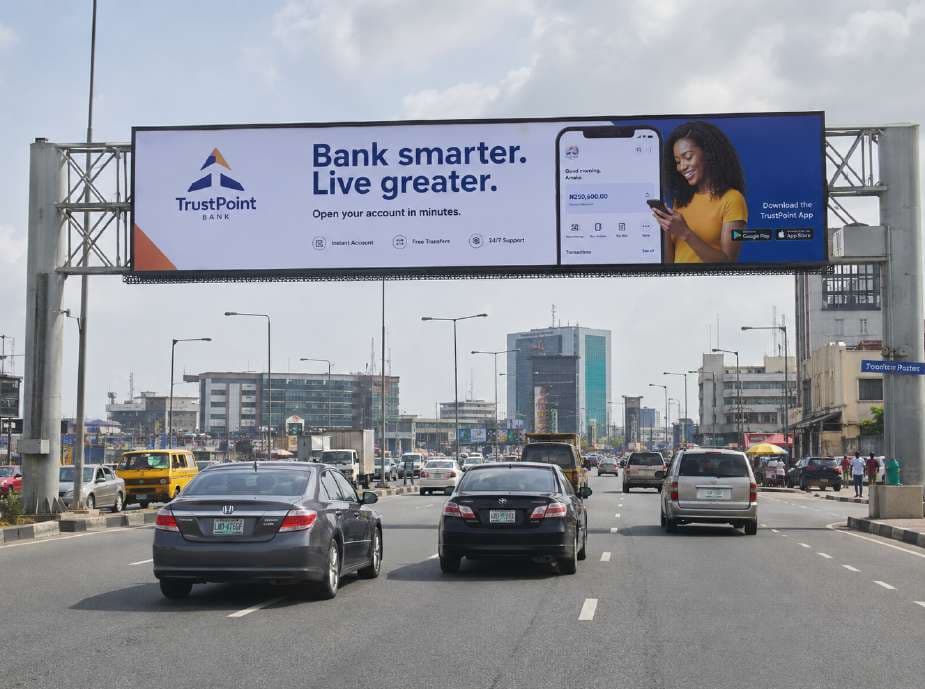
A gantry sits above or stretches across a road, placing the advertisement directly within the audience's line of travel.
Because of this position, gantries can command attention on high-traffic routes. They work well for major launches, broad awareness, category statements and campaigns aimed at motorists and passengers.
They can also support route domination when several placements carry the same campaign message across a corridor.
But gantries are unforgiving. The audience is moving, the road requires attention and the viewing window may be brief.
This is not where a brand should explain its history, introduce six products and include every social media handle. A gantry needs a direct headline, a dominant visual and branding that can be recognised quickly.
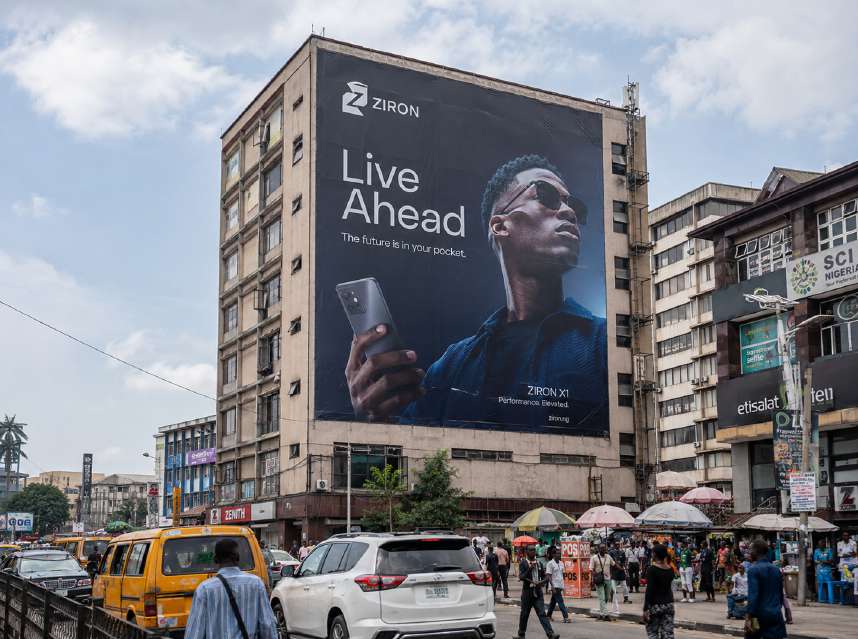
Wall drapes and wallscapes
A wall drape uses the side of a building as a large advertising surface. Its scale can make a campaign feel like it has taken over an entire part of the city.
This format works particularly well for entertainment, fashion, technology, product launches and bold brand statements. It can turn an ordinary building into a temporary landmark.
Wall drapes are strongest when the creative uses the architecture instead of fighting it. Windows, corners, height and the shape of the building should influence the idea from the beginning.
A model can appear to look through a real window. A product can seem to wrap around a corner. The entire building can become part of the visual.
Designing a normal rectangular billboard first and stretching it across a wall is usually a waste of the format. When a brand pays for dramatic scale, the idea should deserve it.
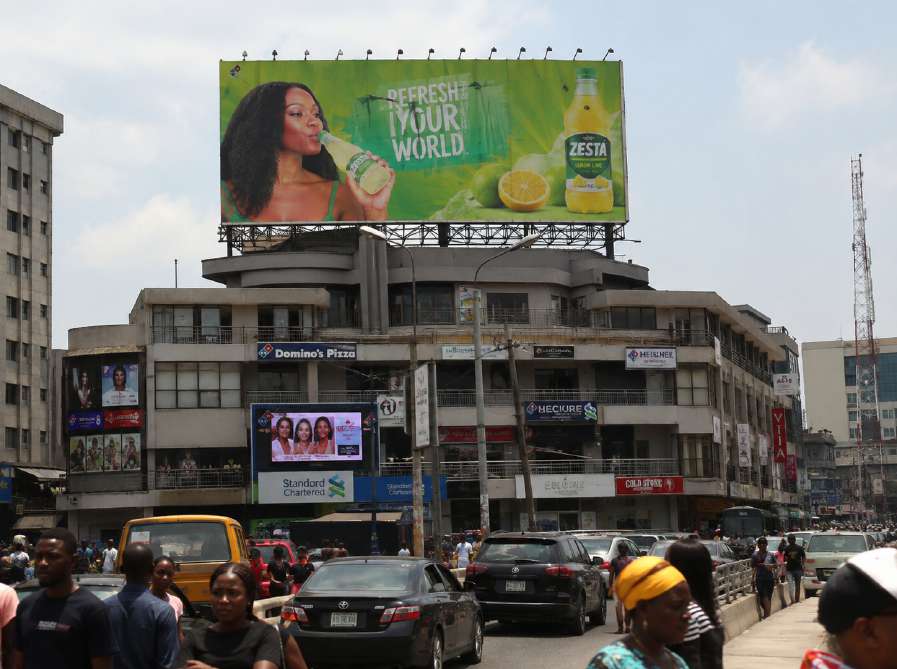
Rooftop billboards
Rooftop billboards are mounted above buildings. Their elevation can improve visibility in dense areas where shops, signs, trees and roadside structures compete for attention at ground level.
They can work well across urban commercial corridors and locations where the audience has a clear, long-distance view of the roofline.
Like unipoles, rooftop boards favour simple creative. Their height means fine details may disappear, even when the board looks large in photographs.
The team should also inspect sightlines carefully. Nearby buildings, road curves and trees may interrupt the view. Lighting matters if the audience uses the route heavily after dark.
Maintenance can be more difficult because the structure is elevated. A light that stops working or a damaged print may remain unnoticed unless monitoring responsibilities are clear.
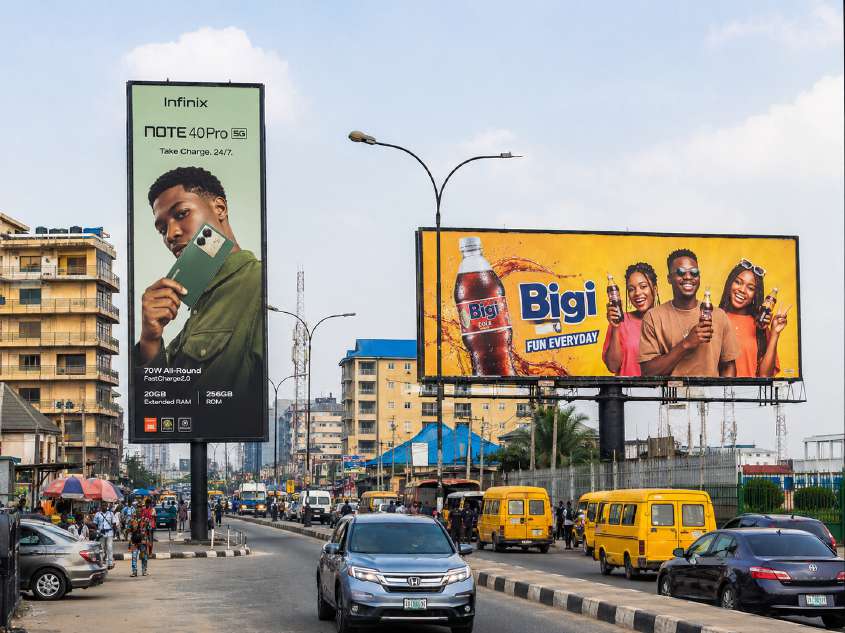
Bridge panels and bridge wraps
Bridge advertising uses the face, sides or supporting parts of a pedestrian or road bridge.
Bridge panels can work well along commuter routes because they sit close to the audience's natural line of sight. A series of bridge placements can also build repeated exposure across one road corridor.
Their shape is often wide and shallow, so the design needs to respect that proportion. Short horizontal headlines, strong contrast and simple visuals tend to work best.
A normal billboard design should not be squeezed until it fits a bridge panel. When letters become shorter, logos become tiny and pack shots lose detail, the creative has not been adapted. It has been damaged.
Bridge wraps allow more of the structure to become part of the campaign. This can create greater impact, but only when the design remains easy to understand from the road.
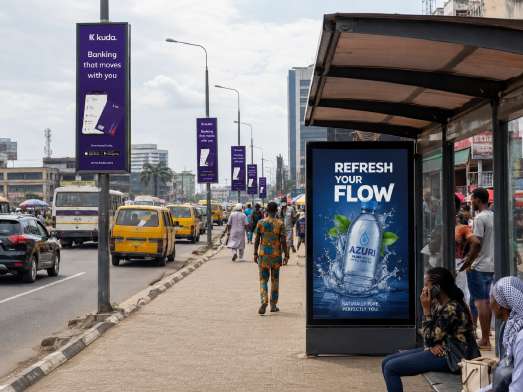
Portrait and landscape billboards
Orientation is not a billboard technology, but it changes how the creative should be built.
Portrait boards work well with:
- A single person or product
- Vertical pack shots
- Stacked headlines
- Strong top-to-bottom hierarchy
- Creative ideas built around height
Landscape boards suit:
- Wide visual scenes
- Short horizontal headlines
- Product-and-message layouts
- Longer road sightlines
- Ideas that use horizontal movement
A portrait board can make one product feel dominant. A landscape board can create more room between the visual and headline.
More room does not mean more content. Landscape formats often tempt brands to add extra products, logos and messages simply because space is available. Empty space is allowed. In fact, it often makes the important elements easier to notice.
Neither orientation is better. The question is whether the idea was designed for that exact shape.
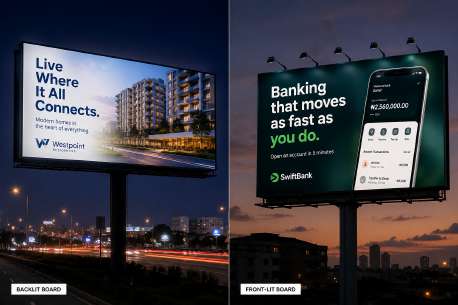
Backlit and front-lit boards
Lighting determines whether a static billboard continues working after dark.
A backlit billboard is illuminated from behind the printed material, creating a more even glow across the surface. A front-lit board uses lamps positioned in front of the billboard face.
Both can improve night-time visibility, especially on routes with heavy evening traffic. But a lighting claim in a media owner's presentation is not enough.
Inspect the board after dark.
Check whether the full surface is evenly lit, whether any lamps have failed and whether nearby streetlights or LED signs overpower the advertisement. Colours and contrast can also behave differently at night.
A campaign aimed at commuters returning home from Victoria Island or Ikeja may depend heavily on evening visibility. Booking a poorly lit site for that audience defeats the plan before the creative has a chance.
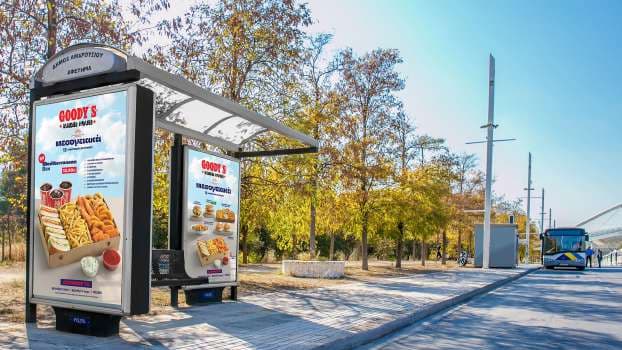
Bus-shelter and street-level displays
Bus-shelter panels and other street-level formats are viewed from a closer distance than highway billboards. People may encounter them while walking, waiting for transport or sitting in slow-moving traffic.
That makes them useful for neighbourhood targeting, retail promotion, local services and commuter campaigns.
They can sometimes carry slightly more detail than a large roadside board. A short product explanation, store direction or QR code may work when the audience is stationary and can engage safely.
But closer viewing is not permission to create a poster full of tiny text. The main message still needs to be obvious before the supporting information is read.
Street-level displays can be particularly useful when the target audience is concentrated around a specific neighbourhood, shopping district, campus or commercial area. A smaller format close to the point of action may produce more value than a prestigious board far away.
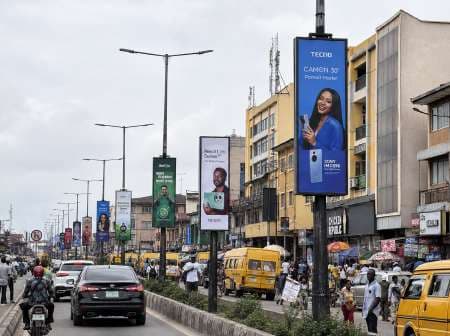
Lamp-post panels
Lamp-post panels place smaller advertisements repeatedly along a road.
Their power comes from frequency. One panel may create a quick impression, but a sequence can repeat a product, introduce several messages or build a story as people move along the route.
They work well for event promotion, route takeovers, product launches and campaigns that benefit from repeated exposure.
For example, the first panel might ask a question, the next might reveal the product and the final panel might carry the call to action. A beverage brand can repeat different flavours. An event campaign can build anticipation as people approach the venue.
Each panel must remain simple. Trying to fit the entire campaign onto every unit defeats the purpose of having a sequence.
The road is the timeline. Use it.
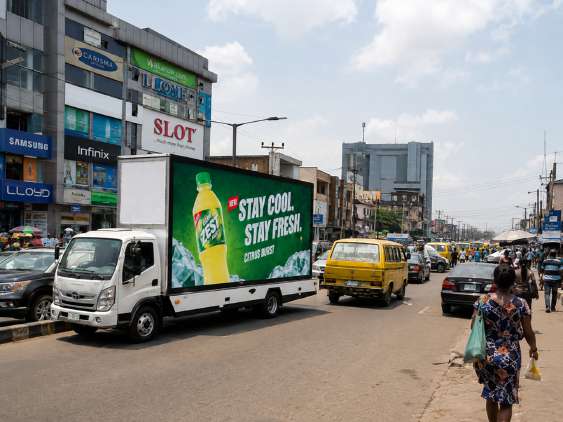
Mobile billboards
Mobile billboards place advertising on a vehicle or purpose-built moving platform. They are part of outdoor advertising, although they are not fixed roadside billboards.
Their movement can help a campaign reach different neighbourhoods, follow selected routes or create attention around an event or activation.
They may work well for product launches, entertainment campaigns, political or public-information communication where permitted, and short promotional bursts.
But mobility needs planning. The team should define routes, operating hours, stopping points and the areas where the intended audience is likely to see the vehicle.
A mobile billboard trapped for hours on an irrelevant route is not flexible media. It is a moving production cost.
The creative must also remain readable while the vehicle is in motion. Large type, high contrast and immediate branding matter even more than they do on a stationary display.
Before booking a digital screen, confirm:
How many seconds each advertisement receives
The total length of the advertising loop
How many other advertisers share the screen
The screen's operating hours
Whether sound is available or relevant
How proof of play will be reported
The exact pixel dimensions and file requirements
Which type should your brand choose?
Start with the campaign, not the media catalogue.
Ask who needs to see the message and where those people move. Consider how fast they will be travelling, how long the display will remain visible and whether the message needs to change during the campaign.
Think about whether continuous presence matters more than flexibility. Confirm whether the route is busiest during the day, at night or across both periods. Decide whether the creative depends on scale, repetition, proximity or movement.
Then inspect the site and verify its approvals.
A static unipole may be right for a long-running brand statement. A digital screen may work better for an event countdown. A bus-shelter panel may outperform both when the audience is local, stationary and close to the point of purchase.
Buying the most expensive format does not guarantee the best outcome. It only guarantees the most expensive mistake when the format does not fit the job.
The decision should always return to the same question: under what conditions will this particular message work best?
A simple format-selection guide
1
Static
Choose static when the message is evergreen and continuous visibility matters.
2
Digital
Choose digital when the message changes, timing matters or the campaign needs several creative versions.
3
Unipole
Choose a unipole when distance, height and scale support the idea.
4
Gantry
Choose a gantry when the message needs direct exposure above a major route.
5
Wall Drape
Choose a wall drape when the creative can turn a building into part of the campaign.
6
Street-level
Choose street-level formats when local targeting, proximity and longer dwell time matter.
7
Lamp-post
Choose lamp-post panels when repeated impressions across a route are more useful than one large placement.
8
Mobile
Choose mobile billboards when planned movement can take the campaign to several relevant locations.
Final thought
The best types of billboards in Nigeria are not automatically the largest, brightest or most talked-about formats. They are the ones that match the audience, route, viewing time and campaign idea.
A board is not a strategy simply because it has been booked. The strategy is the thinking that explains why that format belongs on that road, in front of those people, carrying that message.
Before committing to a placement, compare the board type, dimensions, orientation, traffic direction, lighting, audience and campaign objective.
For help choosing a format that fits the job rather than one that merely fills the media plan, explore Xpark360's billboard advertising service.
Keep Reading
How to Choose a Billboard Location That Actually Reaches the Right People
The right site must put the correct audience in front of the message, give them enough time to understand it and support the action the campaign expects.
Static vs Digital Billboards: Which One Will Work Harder for Your Campaign?
The static vs digital decision should come down to what the campaign needs, not which format looks more modern in a presentation.
How to Write Billboard Copy People Remember After Five Seconds
Impressions are not outcomes. A practical framework for structuring awareness, consideration and conversion spend so the board sees naira, not vanity metrics.