
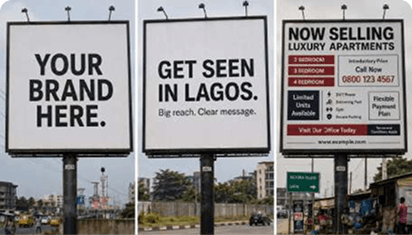
Knowing how to write billboard copy starts with accepting one hard truth: the audience does not owe you its attention.
People may see the board while driving along the Lekki-Epe Expressway, sitting in traffic at Allen Avenue or approaching an Abuja junction. They are watching the road, checking directions, talking to passengers and thinking about where they need to be.
Your billboard has seconds to interrupt that moment.
Good billboard copy is not simply short. It is one clear idea expressed in the fewest words needed to make sense, feel relevant and stay in the mind.
Start with one job
Before writing headlines, complete this sentence:
After seeing this billboard, the audience should remember.
Use one answer.
They may need to remember:
A new product name
A campaign promise
An event date
A store location
A category benefit
A simple action
A distinctive brand idea
When the answer contains several objectives joined by "and", the billboard is probably carrying too much.
A fintech billboard should not introduce the company, explain four services, promote an offer and ask for an app download at the same time. Decide what matters most.
A billboard cannot tell the whole story. Its job is to make one part of the story impossible to miss.
Know the viewing situation
Copy length depends on where and how people will see the board.
A gantry above a fast road needs a very short message. A bus-shelter panel viewed by waiting commuters can carry slightly more detail. A digital screen may use several frames, but each frame still has to work quickly.
Before writing, ask:
Is the audience driving, walking, sitting or waiting?
How far is the board from the road?
How long will it remain visible?
Is the environment visually crowded?
Is the brand already familiar?
Will the visual explain part of the message?
Is the call to action realistic for that location?
Copy for a board near a traffic light in Ikeja may have more breathing room than copy placed above vehicles moving along Abuja Airport Road.
Write for the road, not for the presentation deck.
Do not worship a fixed word count
You will often hear that a billboard should contain six or seven words. That is a useful warning against clutter, not an unbreakable rule.
"Open today. Two minutes ahead." has five words and does a clear job.
A familiar brand may need only two words. An event billboard may need a name, date and venue. A street-level panel may carry a short supporting sentence.
The better rule is simple: remove every word the audience does not need.
Do not cut so aggressively that the message loses meaning. But do not keep a word because someone in the meeting likes how it sounds.
Every word should earn its space.
Put the idea before the information
Information tells people what is being advertised. An idea gives them a reason to notice it.
Informational version:
New high-speed internet package now available
Idea-led version:
Buffering has left the building.
The second line still needs the product and brand to make sense, but it has a point of view. It gives the audience something more memorable than an announcement.
Strong billboard headlines may use:
A sharp benefit
A surprising contrast
A familiar truth
Humour
A visual pun
A local observation
A confident statement
A direct instruction
A simple question
A phrase people can repeat
The approach must fit the brand. Forced cleverness is obvious, especially when slang or humour has been added only to make safe copy look interesting.
A billboard should sound confident because the thinking is clear, not because the headline is shouting.
Let the visual do some work
Copy and design should not repeat each other.
When the visual already shows a cold bottle covered in condensation, the headline does not need to say, "Our drink is cold and refreshing." It should add another layer to the message.
Think of the billboard as one sentence written with words and images.
The copywriter should know:
What the main visual will be
Where the product will appear
How the logo will be positioned
What the surrounding environment looks like
Whether the physical structure can become part of the idea
The designer should understand which message comes first and what the audience must remember.
When copy and design are developed separately, both sides often try to explain everything. That is how crowded billboards happen.
Make the brand easy to identify
Some famous brands can remove their logo and still be recognised through colour, packaging or tone.
Most brands should not copy them.
Make it easy for the audience to identify who is speaking, what category the message belongs to and which product or service is being promoted.
The logo does not need to dominate the entire board, but it must survive distance and movement. The same applies to the product name.
A clever headline that people remember without remembering the advertiser has done free work for the category.
Brand recognition should be built into the idea, not added as a tiny logo after the creative team finishes having fun.
Write for sound as well as sight
A billboard is visual, but a good headline often sounds natural in the reader's head.
Use short words, clean rhythm and familiar phrasing. Read the line aloud. If it feels awkward to say, it may also feel awkward to process quickly.
Avoid corporate filler, long technical language, unexplained abbreviations and generic promises that could belong to any company.
"Experience innovative excellence" says almost nothing.
"Your money moves before traffic does" creates an image and connects the promise to a familiar Nigerian frustration.
The line should sound like something a person could remember and repeat, not a sentence copied from a company profile.
Use local relevance carefully
A Nigerian billboard can use local language, humour and shared experiences. Traffic, power, food, football, family and city life all contain truths people recognise immediately.
But local relevance must feel natural to the brand and understandable to the audience.
Adding slang to look young is not insight. Using a cultural reference that half the target audience cannot understand is not smart targeting.
The meaning should also be checked carefully. A harmless phrase in one context may carry a different interpretation elsewhere.
Test the line with people who understand the audience. Check pronunciation, tone and possible unintended meanings before the campaign reaches the road.
Local writing works best when people feel seen, not when they feel the brand is trying too hard to sound like them.
Choose one call to action
A billboard may ask people to:
Visit a nearby location
Remember a brand name
Search a short phrase
Attend an event
Use a short web address
Call a memorable number
Scan a QR code in a safe, stationary environment
Look for a product in stores
Choose the action that best fits the campaign.
Do not ask people to call, scan, download, follow, visit and search at the same time.
A driver should not be expected to scan a QR code. A passenger or pedestrian may be able to. A long phone number is difficult to remember. For some campaigns, the brand name itself is the strongest call to action.
One clear next step is stronger than six small instructions.
Writing directional copy
Directional billboards need clarity before cleverness.
Useful details may include:
Distance
A recognisable landmark
A clear arrow
A simple destination
A reason to stop
Example:
Lunch is 500 metres ahead. →
A direction should help people act while they are still close enough to do so. "Visit us in Lagos" is not useful when the audience needs to know which turn to take.
Do not bury the direction inside a joke that takes too long to understand. The arrow, distance and destination should remain easy to process from the road.
Writing for digital billboards
Digital boards allow messages to change, but each frame should still have one job.
A simple sequence could be:
Frame 1: Introduce the problem
Frame 2: Reveal the answer
Frame 3: Show the brand and action
However, each frame should remain understandable on its own. Someone may look up during the second frame and miss the first completely.
Do not hide the brand until the final second. Do not create a long animation that requires the audience to watch from beginning to end.
Digital flexibility is useful, but it is not permission to turn a billboard into a television advert.
Dynamic messages should also be checked for accuracy, context and approval before going live.
A practical billboard-copy process
Write the single-minded proposition
Write the audience truth
List the non-negotiable information
Write many rough lines
Remove explanation
Place the line in a rough layout
Test for five seconds
Check the road context
Check compliance and claims
Before-and-after examples
These examples are fictional and show the editing principle.
Too much:
Get fast, reliable and affordable deliveries across Lagos with our trusted logistics service today.
Tighter:
Lagos delivered before "Where are you?"
Too generic:
Quality banking solutions for all your financial needs.
Tighter:
Your next move should not wait for your bank.
Too many actions:
Download the app, follow us, call 0800 and visit our website.
Tighter:
Search BrightPay. Move money.
The tighter line is not automatically the final answer. It still needs the right visual, brand voice, site and approval.
Short copy can still be weak copy. The goal is not only to cut words. It is to sharpen the thought.
A billboard-copy checklist
Before approving the line, ask:
Does it communicate one main idea?
Can it be understood quickly?
Is the brand clear?
Does the visual add rather than repeat?
Is every word necessary?
Does the language sound natural?
Does the call to action fit the location?
Will the type be large enough?
Can the claim be supported?
Has someone outside the team tested it?
Does it still work without the strategy presentation?
When several answers are uncertain, the headline is not ready.
Final thought
Billboard copy is not a summary of the campaign. It is the sharpest expression of it.
Choose one thing to say, write it for the real viewing situation and let the visual carry its share of the message. The result should be clear enough to understand in seconds and distinctive enough to remember afterwards.
For the visual side of the job, read our billboard design tips.
Before your next headline reaches a Nigerian road, let Xpark360's billboard advertising service test whether it can survive five seconds and still leave the right thought behind.
Keep Reading
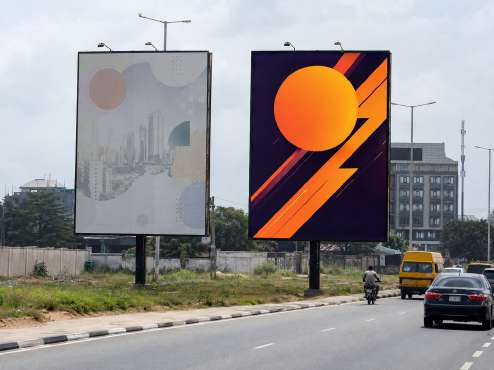
Billboard Design Tips: Make Your Idea Survive the Nigerian Road
A beautifully produced ad for a brand nobody can describe is expensive wallpaper. Sharpen the sentence before you increase the budget.
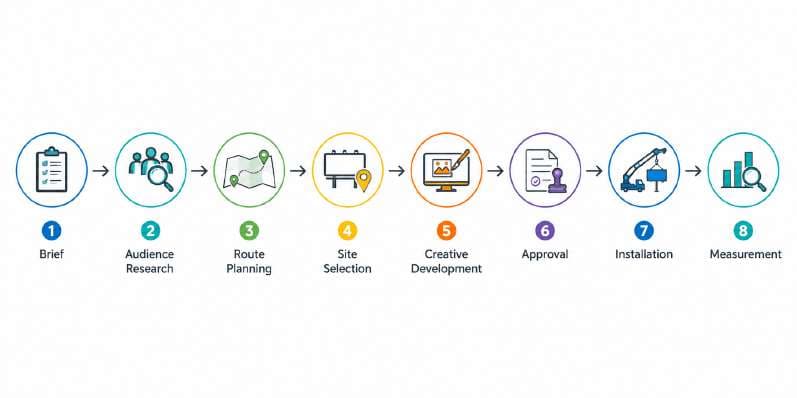
How to Plan a Billboard Campaign From Brief to Measurable Results
A media owner sends over a list of vacant boards. The smarter response is to pause and plan from the business problem first.
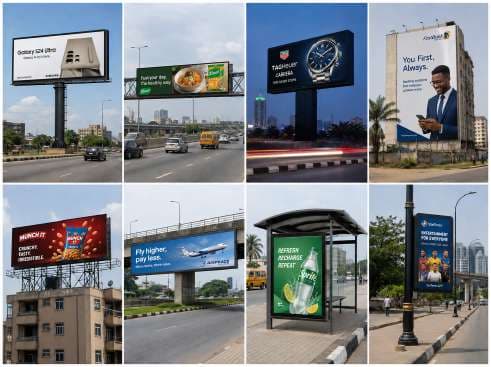
Types of Billboards in Nigeria: What to Use, Where and Why
The different types of billboards in Nigeria are built for different viewing conditions. The right format gives your message the best chance of being noticed.