
A media owner sends over a list of vacant boards. The easy response is to circle the famous locations and ask for prices.
The smarter response is to pause.
How to plan a billboard campaign begins with the business problem, not the available inventory. Once the objective, audience and message are clear, the team can choose formats and locations with purpose instead of forcing the campaign into whichever boards happen to be open.
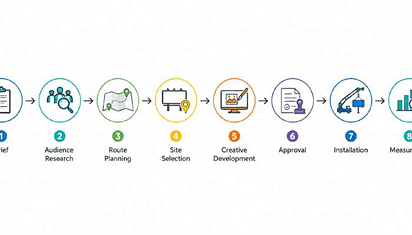
The process below takes a billboard advertising campaign from the first brief to installation, monitoring and measurement. A board going live is an important moment. It is not the end of the work.
Step 1: Define the business problem
What needs to change in the business?
The campaign may need to:
Introduce a new product
Build awareness in a city
Drive visits to a branch
Promote an event
Give a digital brand physical credibility
Support seasonal demand
Announce expansion into a new market
"We want to run billboards" is not a business problem. It is a media request.
A better starting point would be: "Our new service is available in Lagos, but too few professionals know it exists."
That problem gives the campaign something specific to solve.
Step 2: Set a clear communication objective
Decide what the audience should know, feel or do after seeing the campaign.
A useful objective identifies:
The priority audience
The message
The location
The campaign period
The intended result
For example:
Make the new service familiar among professionals travelling through the Ikeja business corridor before the September launch.
That gives the media and creative teams more direction than "Create awareness in Lagos."
The objective should be clear enough to guide site selection and specific enough to measure later.
Step 3: Define the audience
Go beyond age, gender and income.
Understand where the audience lives, where they work, how they travel and which routes connect those places. Consider when they move, whether they are usually drivers, passengers or pedestrians and what may already be competing for their attention.
A campaign targeting senior executives may focus on airport routes, Victoria Island, Ikoyi or Abuja's commercial districts. A campaign aimed at university students will need a different map entirely.
Audience movement is the bridge between brand strategy and billboard location.
When the audience definition is vague, the media plan usually becomes a list of popular roads.
Step 4: Map the routes
Plot the audience's likely movements across weekdays, weekends and relevant event days.
Group routes into:
Primary daily routes
Secondary routes
Airport or travel routes
Commercial districts
Residential areas
Retail and entertainment areas
Event routes
Weekend routes
Note the direction of movement, likely travel time and reason for each journey.
The morning trip from the Mainland to Victoria Island is a different media opportunity from the evening return. The road towards Landmark Centre matters differently on an event day. Abuja Airport Road carries different audience moments from Wuse or the Central Business District.
Route mapping helps the team decide whether the campaign needs one dominant site, repeated coverage along a corridor, neighbourhood penetration or a multi-city network.
Step 5: Decide the role of billboard advertising
A billboard can lead the campaign or support another channel. Write down its job.
It may need to:
Introduce the campaign idea
Make the brand name familiar
Reinforce television or radio
Give an audio campaign a visual identity
Direct people to a nearby branch
Build launch scale
Promote an event
Encourage branded search
Dominate selected commuter routes
This decision shapes the message and measurement plan.
A billboard that exists mainly to build recognition should not be judged like a directional board. An event board should not carry the same call to action as a long-term brand campaign.
Billboards work better when they have one defined role, not when they are expected to do everything.
Step 6: Select formats
Choose the format based on the campaign job and viewing conditions.
Static boards work well when one message needs continuous presence. Digital screens suit countdowns, dayparting, changing content and several creative versions.
Unipoles and gantries can create scale across major routes. Wall drapes can turn a building into part of the campaign. Street-level formats may provide closer viewing and stronger neighbourhood relevance.
The brightest or largest format is not automatically the right one.
Before choosing, read about the types of billboards in Nigeria and compare the campaign's need for scale, flexibility, proximity and repetition.
The format should help the idea work. It should not be selected because it looks impressive in a mock-up.
Step 7: Build a site shortlist
For every proposed billboard, collect:
Location and map coordinates
Traffic direction
Dimensions and orientation
Format
Lighting
Recent approach photographs
Available traffic or audience information
Nearby landmarks
Visual clutter
Approval status
Availability dates
Monitoring process
Score each site against audience fit, visibility, viewing time, context and operational risk.
A famous location with weak audience relevance should not automatically outrank a less prestigious site that the target audience passes every day.
The shortlist should explain why every board deserves a place in the campaign.
Step 8: Inspect or verify the sites
Visit important locations or request recent approach videos.
Check the sightline, angle, road speed, night visibility, physical condition and surrounding advertisements. Confirm that the proposed face matches the photograph and that the target audience actually uses the route.
A close-up picture can make almost every billboard look attractive. What matters is how the site appears from the audience's direction of travel.
Look for trees, buildings, bridges, road signs and other structures that may block the message. Check whether lighting works after dark and whether traffic moves too quickly for the proposed copy.
In Lagos, LASAA's official directory can be used where relevant to help check approved practitioners and billboard locations.
For a fuller site-assessment process, read how to choose a billboard location.
Step 9: Write the single-minded proposition
The single-minded proposition is the one belief the campaign needs to establish.
It is not necessarily the final headline. It gives the creative team a clear direction.
For example:
For busy Lagos professionals, this service is the fastest way to complete the task without adding another stop to the day.
The copywriter and designer can now find a shorter, more memorable way to express that thought.
When the proposition contains several unrelated benefits, the campaign has not made a decision. One board cannot credibly promise speed, affordability, prestige, convenience, innovation and trust at the same time.
Pick the point that matters most.
Step 10: Develop copy and design together
The copywriter and designer should work from the actual site dimensions and viewing conditions.
Develop:
The main campaign line
The dominant visual
Brand placement
Product information
Call to action
Required disclaimer
Static and digital versions
Portrait and landscape adaptations
Site-specific executions where useful
Do not write a full message first and ask the designer to "make it fit". Do not build a beautiful layout and leave a small corner for the headline.
Words and images should share the work.
Test every mock-up from a realistic distance and within the likely viewing time. When the team needs a long explanation before the idea makes sense, it is not ready for the road.
Step 12: Complete approvals
Separate the approvals required for:
Advertising content
Sector-specific claims
The billboard structure and location
Production and installation
Final client sign-off
ARCON's published process requires pre-exposure clearance for advertisements within its vetting categories. In Lagos, LASAA regulates outdoor advertising structures and permits.
Requirements may differ across sectors, states and local authorities. Confirm them early instead of waiting until the artwork is ready for printing.
Keep the approved artwork, approval documents, media order and final production file together. The live board should match the approved version.
The wider compliance process is covered in our guide to billboard advertising regulations in Nigeria.
Step 11: Plan the campaign duration
Duration should reflect the objective, audience travel frequency and number of sites.
A short burst may create urgency before an event or launch. A brand-awareness campaign may need several weeks of repetition. A permanent directional board can remain useful much longer.
Also consider:
How quickly the message may become outdated
Whether the campaign uses static or digital boards
Support from television, radio or digital media
Production and approval timelines
The planned measurement period
Allow enough time for approvals, production and installation.
A delayed process should not turn a planned four-week campaign into one rushed week because the event date cannot move.
Step 13: Prepare artwork and production
Request the current specification for every billboard face.
Confirm:
Exact dimensions
Bleed and safe area
Resolution
Colour mode
File format
Digital pixel dimensions
Maximum file size
Animation or frame rules
Display duration
Installation method
Production deadline
Do not rely on specifications from an old campaign. Two structures with similar names may still have different production requirements.
Proofread the artwork at full size and in a small preview. The large view helps catch production errors. The small view shows whether the headline, visual and brand can survive distance.
Step 14: Coordinate installation
Create a clear installation schedule.
Assign responsibility for printing, transport, access, installation, electrical checks, digital uploads, photography, client confirmation and correction of defects.
Confirm when each location will be ready and who will report problems.
The campaign start date should mean that the board is live, correct and verified. It should not mean that installers have only started travelling to the site.
Build contingency time for weather, access problems, production delays and technical faults.
Step 15: Collect proof of posting
Proof of posting should include:
Date-stamped photographs
Day and night images where relevant
Photographs from the audience's approach
Close views showing production quality
Confirmation of the correct billboard face
Digital proof of play
Notes on faults or delays
One close-up photograph is not enough.
It can prove that material was installed, but it cannot prove that the headline is visible from the road or that the screen is operating at the agreed time.
Good proof shows both delivery and real-world visibility.
Step 16: Monitor the campaign
Set a monitoring schedule before launch.
Check:
Print condition
Lighting
Digital operation
Correct creative
Display rotation
Obstruction
Weather or vandalism damage
New competing structures
Whether reported faults are repaired
Digital screens should be checked against the agreed display duration and loop. Static boards should be inspected for loose material, fading or lighting failures.
Record when each issue was reported and resolved.
A billboard campaign cannot be left unattended simply because the installation photographs looked clean.
Step 17: Measure performance
Choose KPIs before the first board goes live.
Possible measures include:
Estimated impressions
Reach and frequency
Brand recall
Branded search
Website traffic
Calls and enquiries
Footfall
Event registrations
Sales movement
Social conversation
Location-based comparisons
Survey responses
Record a pre-campaign baseline and compare results with the original objective.
Do not force every billboard into a click-ad measurement model. Outdoor advertising can influence familiarity, search, visits and later action without receiving the final digital credit.
The full framework is explained in our guide to measuring billboard advertising effectiveness.
Step 18: Debrief
After the campaign, document:
Which locations delivered the strongest result
Which creative was easiest to recall
Whether the duration was sufficient
Which operational problems occurred
Which tracking methods worked
Which sites should be reconsidered
What the next campaign should change
Do not end the campaign with a folder of installation photographs and no learning.
A billboard campaign should improve the next billboard campaign. The debrief turns experience into a planning advantage.
A compact pre-launch checklist
Before the first board goes live, confirm:
Business problem
Communication objective
Target audience
Route map
Billboard's role
Format choice
Verified sites
Approved creative
Correct artwork specifications
Installation plan
Proof-of-posting requirements
Monitoring schedule
Baseline data
Campaign KPIs
Connections to wider media
Post-campaign review date
For campaigns using several channels, read our guide to billboard advertising and digital marketing before finalising the timetable.
Final thought
Learning how to plan a billboard campaign means understanding that every decision affects the next.
The objective shapes the audience definition. The audience shapes the route. The route shapes the site. The site shapes the creative. The campaign role shapes the measurement plan.
Plan those parts together and the billboard has a clear job. Plan them separately and the result may be a collection of expensive surfaces with no shared logic.
Do not let a vacant-site list write the strategy. Let Xpark360's billboard advertising service move the campaign from the business problem to a live board that still makes sense from the road.
Keep Reading
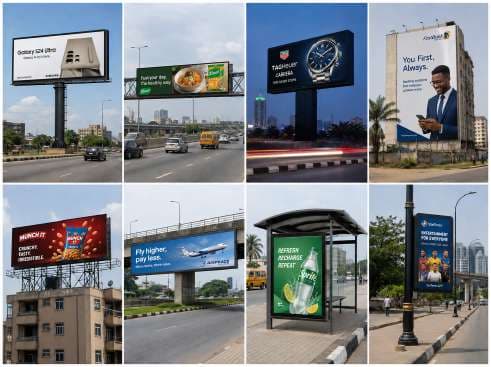
Types of Billboards in Nigeria: What to Use, Where and Why
The different types of billboards in Nigeria are built for different viewing conditions. The right format gives your message the best chance of being noticed.
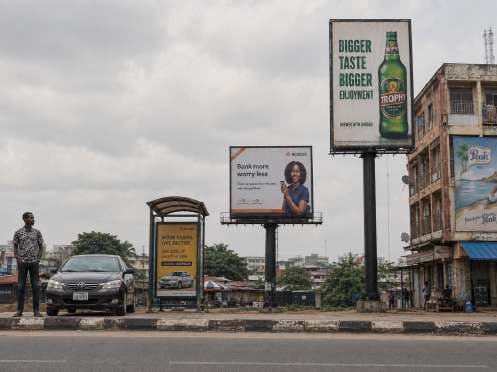
Billboard Sizes in Nigeria: Why Bigger Is Not Always Better
Billboard sizes in Nigeria should never be judged by scale alone. The useful question is which size gives this message the best chance of being noticed.
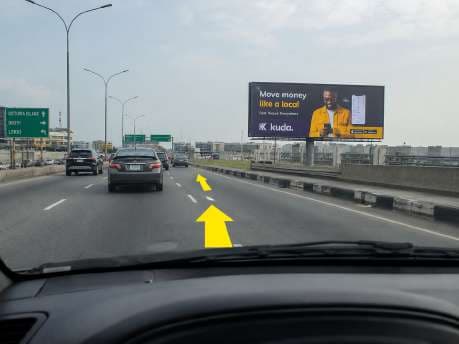
How to Choose a Billboard Location That Actually Reaches the Right People
The right site must put the correct audience in front of the message, give them enough time to understand it and support the action the campaign expects.